Sign up for a 30-day trial today.

Smart. Trusted. Safe Navigation.
A guiding light that empowers users to navigate with confidence, independence, and peace of mind.
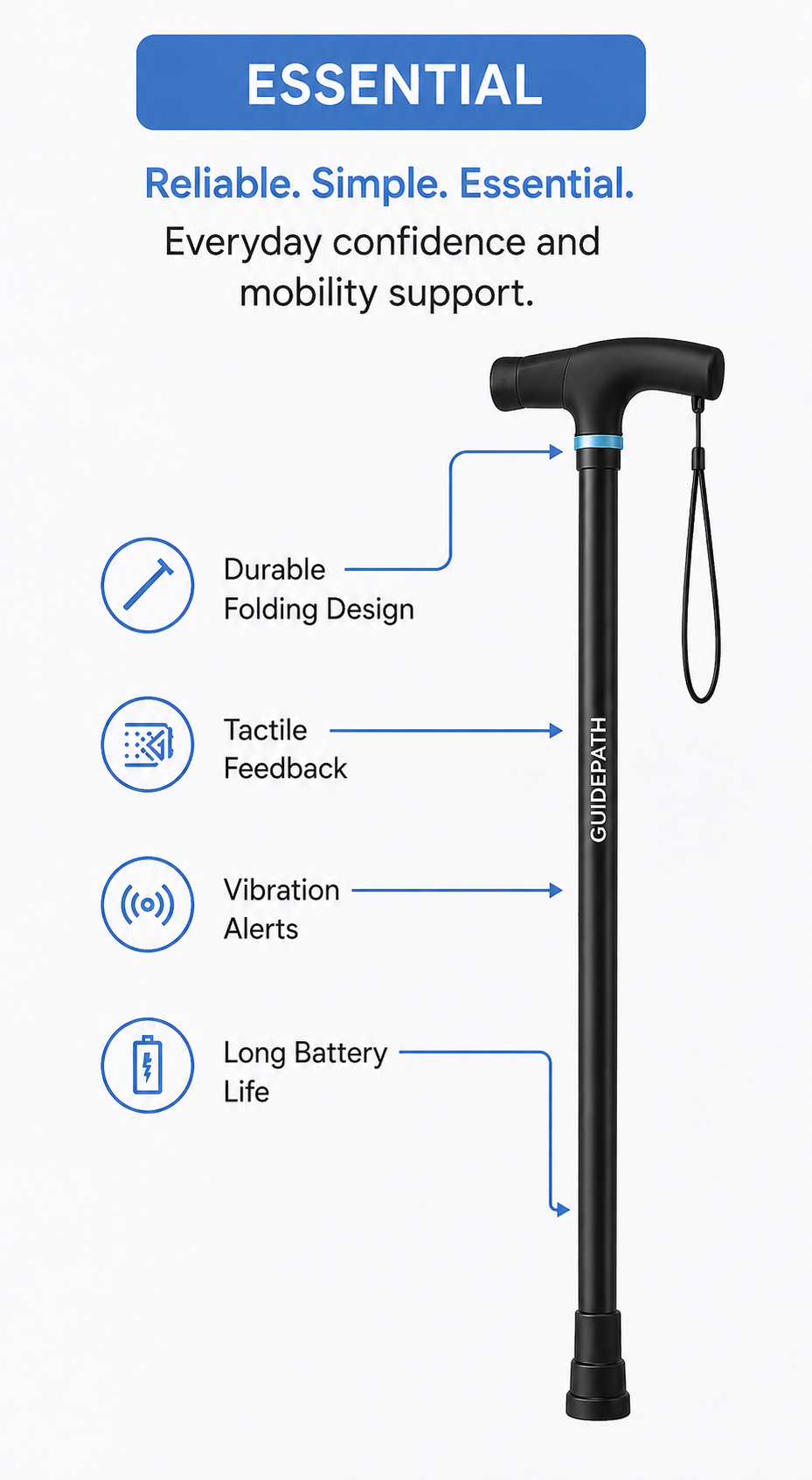
The standard model will serve as the initial working model using a traditional white cane structure with an ultrasonic sensor, vibration motor, Arduino microcontroller, and battery pack. This model will detect nearby obstacles and warn the user through basic haptic feedback. For example, when the cane identifies an object in front of the user, the handle will vibrate. As the obstacle gets closer, the vibration will become stronger or faster. This version will be a step above a traditional white cane, providing more information than physical contact alone.
Step-by-Step Prototype Development Strategy
Purpose: Design a cane that can both detect obstacles and warn the user before contact.
Step 1: Build the Foundation – Start with a standard white cane frame. Attach an Arduino microcontroller, ultrasonic sensor, vibration motor, and portable battery pack.
Step 2: Program Obstacle Detection – Code the ultrasonic sensor to measure distance from objects in front of the cane.
Step 3: Add Haptic Feedback – Connect the sensor to a vibration motor in the handle. The vibration becomes faster or stronger as the object gets closer.
Step 4: Test Controlled Obstacles – Test the cane with walls, chairs, boxes, cones, and doorways at different distances.
Step 5: Measure Success – Record detection distance, response time, vibration clarity, battery life, and user comfort.
Step 6: Revise Design – Adjust sensor angle, vibration intensity, handle placement, and battery position based on test results.
| Model Components | Estimated Cost |
| White Cane | $25 |
| Arduino Nano | $15 |
| Ultrasonic Sensor | $5 |
| Vibration Motor | $5 |
| Rechargeable Battery Pack | $15 |
| Wiring & Housing Materials | $10 |
| Mounting Brackets & Fasteners | $10 |
| Testing Supplies | $15 |
| Total Model Costs | $100 |
Development Time and Cost
Project Activities
- Arduino Programming
- Sensor Calibration
- Vibration Pattern Testing
- Battery Optimization
- User Testing
Development Time: 40–60 hours
Development Cost: $500–$2,000
| Commercial Components | Estimated Cost |
| Electronics | $20 |
| Cane Assembly | $15 |
| Housing & Packaging | $10 |
| Quality Control | $5 |
| Total Manufacturing Costs | $50 |

This advanced model will go beyond obstacle detection to recognize terrain-related hazards. Additional sensors will identify curbs, stairs, potholes, inclines, drop-offs, uneven pavement, and changes in elevation. This will also include differentiated vibration patterns so users can distinguish between different types of hazards. For example, a pulsing vibration may indicate a step down, while a steady vibration may indicate an object ahead. The base of the cane could also be redesigned for greater stability, using a wider tip or small rolling support to reduce friction and make walking smoother.